
As a creative sales representative who represented commercial photographers, a veteran marketer, and a public relations professional, I know firsthand that trade show marketing is not only effective but also still highly relevant even in today’s digital landscape.
Setting aside my professional opinion and looking at it from the consumer’s perspective, I will continue to affirm that trade show marketing works very well. For example, when my sons were little, we would take them to a local town’s annual 4th of July fireworks extravaganza that included:
- Fireworks at dusk
- Inflatable bounce houses
- Inflatable bounce houses with water slides and pools
- Sprinkler and splash pad
- Live music all day at the small amphitheater
- Food trucks
- Small business showcase and art fair with trade show exhibits such as caricature artists, henna tattoo artists, a face-painting station, a vendor market, putt-putt/mini golf, balloon art, a playground, and a ropes course, just to name a few.
It was at the vendor market where we would run into unique finds like these spice packets (spicy and sweet), which we sampled there. We usually bought several packets and then reordered the ones we enjoyed most from their website until the following year.
Trade show marketing, according to the event experts at Cvent, “Trade shows, often called expos, are significant events where companies gather to showcase their latest products and services. In the bustling world of commerce and competition, trade shows are more than just corporate gatherings—they are arenas of opportunity, acting as the nexus point for innovation, collaboration, and growth.
Both in-person and virtual trade shows provide a vibrant platform for interaction, negotiation, and mutual learning and serve as melting pots of ideas where the latest trends and innovations are displayed, discussed, and dissected.
Key Elements of a Trade Show
- Exhibitors
- Trade Show Booths
- Attendees
- Seminars and Presentations
- Networking Opportunities
- Show Services,”.
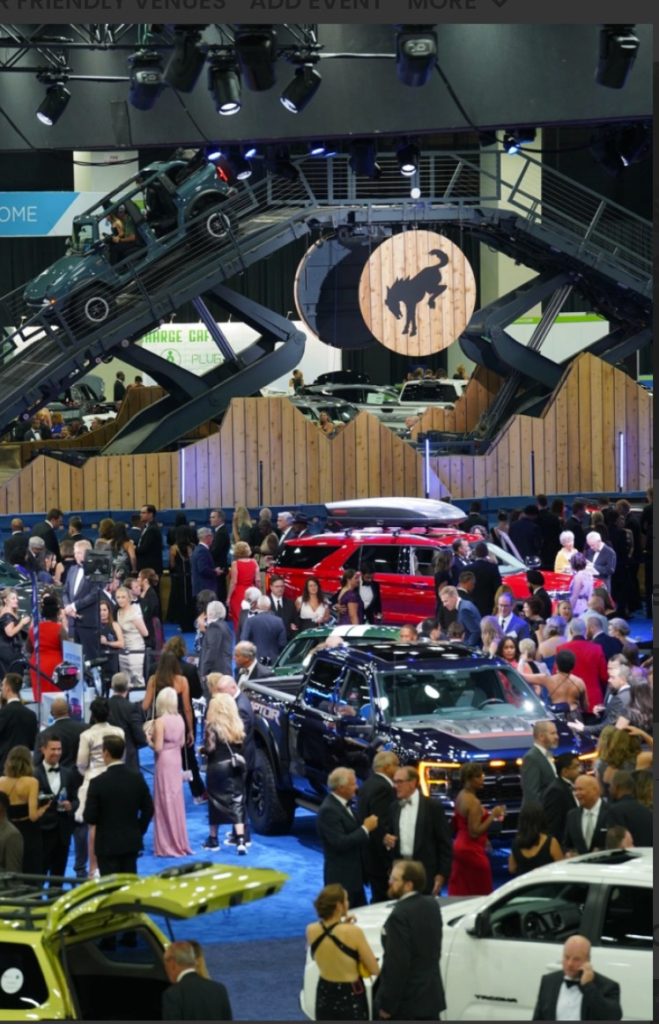
(Photo Credit: Car Events Detroit Auto Show)
Why attend a trade show
Some of the key reasons to attend trade shows are to raise brand awareness, nurture business relationships, secure targeted leads, conduct competitor analysis, and educate the industry.
When I worked on the sales side of marketing as a creative representative, my job entailed attending trade shows to build brand awareness by showcasing my commercial photographers’ work.
Some of the strategies we implemented were:
- Big-screen TV’s constantly stream our photographers’ images
- Contests to win free headshots for visitors who leave their business cards in our contest jar
- Provide unique food and beverages to interested visitors
- Pens, pads of paper, letter openers, etc., with logo to hand out for free to booth attendees
For the role of a salesperson in the creative industry, you must get out there and meet people where they are. In other words, this type of salesperson must be out networking regularly, attending trade shows, business growth events and luncheons, industry events, and awards galas, and volunteering on industry-related boards to find the decision-makers needed to build relationships, secure new business, and generate sales.
For example, below is a list of some of those groups that were worthy of networking with:
- University Event Planners Association (UEP)
- Automation Alley
- Society of Marketing Professionals Services (SMPS)
- American Advertising Federation / Ann Arbor Chapter (A2AC)
- University of Michigan Alumni Association Board of Governors
- Motor City Connect (MCC)
- American Marketing Association (AMA)
- Direct Marketing Association of Detroit (dMAD)
Sometimes I would attend trade shows as a guest, not a participant, for networking purposes. For instance, I would attend food-related trade shows since we shot a lot of food photography. Of course, I didn’t mind enjoying all of the food samples I was privy to as an attendee!
Growing up in Southeast Michigan, I have been to one of the largest trade shows in the world – The North American Auto Show. I have attended the Auto Show so many times that I have lost count. Then, as a mom, I took my oldest son, who is a real car enthusiast, many times as well. In fact, this kid is such a car lover that he would rather go to the Auto Show than Disney World!
Wikipedia notes that, “The Detroit Auto Show, formerly known as the North American International Auto Show (NAIAS), is an annual auto show held in Detroit, Michigan. Hosted at Huntington Place (formerly Cobo Center) since 1965, it is among the largest auto shows in North America, and is widely regarded as one of the automotive industry’s most important events.
The show is organized by the Detroit Auto Dealers Association (DADA), and has been held annually in January for much of its recent history.
In 1899, William E. Metzger helped organize the Detroit Auto Show, only the second of its kind, after the 1898 Paris Auto Show. An auto show was held in Detroit in 1907 at Beller’s Beer Garden at Riverside Park and since then annually except 1941–1953. During the show’s first decades of existence it portrayed only a regional focus. In 1957 international carmakers exhibited for the first time.
In 1987, the DADA proposed that the show become international. The members of the DADA went to places such as Europe and Japan in the attempt to convince those unveiling their new brands or vehicles in those countries to bring those unveilings to the North American Auto Show. That attempt proved to be successful; the North American Auto Show was then renamed the North American International Auto Show in 1989. The NAIAS was the first (and, until 2006, only) auto show in the United States sanctioned by the OICA,”.
Trade show strategy
When I was an attendee versus an exhibitor, my strategy was to “work the room.” I went to all the exhibits that I foresaw being able to partner with in some shape or form. At each booth, I would introduce myself to whoever was running it, spark a conversation, get to know them and their product/service, accept whatever swag they were handing out, and then promptly follow up after the show.
Here are some more recommended strategies to put into action before, during, and after a trade show:
- Giveaways
- Boothe design
- Choose the right trade shows
- Define your goals
- Capture leads effectively
- Email marketing
- Social media
- Identifying the target audience
- Post-trade show follow-up
- Prioritize leads
- Trade show marketing services
- Conceptualize a strong booth presence
- Create interactive experiences
- Direct mail
- Engage with attendees
- Follow up
- Leverage social media
- Prepare marketing materials
- Visualize your booth from multiple sides
- An in-booth presentation
- Create a budget
- Freebies
- Interactive booths
- Networking
Trade show marketing
In conclusion, trade show marketing remains a powerful way to build relationships, showcase value, create memorable experiences, and turn genuine conversations into lasting business opportunities.